Shower being removedEverything I normally write is about building your brand new awesome shower. However, to do that you must first remove the old, outdated, non-awesome shower. There are several ways to do this, I’m gonna show you the easiest.

A lot of people will go in and chip every tile off the wall (don’t laugh, they do it…), then remove the drywall (or what’s left of it) to get down to the studs in order to build the new stuff. You don’t need to do that. It’s time-consuming, messy and will give you a fairly crappy attitude about the project right from the get-go. (Did I just type ‘get-go’??? I need a beer…)


tile with bullnose removedMost existing tiled showers being torn out are ‘builder’s grade’ showers, that means 4×4 or 6×6 tiles with a bullnose tile, normally 2″ wide, along the edges. Chipping each tile off the wall will waste an entire day. So you’re going to remove entire portions of the wall at a time.

The first thing you want to do is chip off the bullnose, or little rounded pieces, along the edges (and top, if you’re not going to the ceiling) of the shower. If you notice in the photo to the right I’ve already done this. [continue reading…]

One of the most frequent questions I get asked is ‘What size and type of trowel should I use for…?’  The proper answer to that is ‘whichever trowel gives you the proper coverage for your particular installation’.

So there really isn’t one perfect answer to that question, a lot of factors are involved. But I’ll try to help you out.

Proper thinset coverage

The first thing you need to know is what constitutes proper coverage.  As stated in ANSI A108.5 3.3.2 for installation of tile on floors; “Average uniform contact area shall not be less than 80% except on exterior or shower installations where contact area shall be 95% when no less than three tiles or tile assemblies are removed for inspection. The 80% or 95% coverage shall be sufficiently distributed to give full support to the tile with particular attention to this support under all corners of the tile.”

Let me translate that for you:

[continue reading…]

When you build a shower you will eventually need to make some holes in it – it’s just part of the overall process. You’ll need to install frames or hinges for your shower doors, grab bars, shower curtain rods, a picture of your pet iguana – whatever. The problem is that now you have that completely waterproof shower you really don’t want to go poking holes into the waterproofing.

No matter which waterproofing method you’ve used any fastener penetrations will have to punch a hole into it. You want to make sure you install your screws properly in order to maintain the integrity of the waterproofing. You don’t want to ruin all your hard work because you need to drive a screw through it!

The first thing you need to do is mark the exact locations of your screw holes. Most things like grab bars come with little templates you can hold up and get exact placement. With shower door frames and stuff like that you can hold up the frame piece and mark the correct location.

[continue reading…]

Completed nicheIn my previous post I showed you how to make a niche for your shower out of Kerdi-board. If you haven’t read that you probably should. It’s gonna be really difficult to install a Kerdi-board niche if you don’t have one.

Just sayin’.

When I install shower niches I prefer for the edge of the niche to be lined up with the grout lines in the tile installation. This way it looks like it belongs there rather than looking like something that was an afterthought (I HATE that…). So it requires planning.

When I build my niche I make it the same size as the tile I’m installing (or a multiple of those tiles, like two tiles high by one tile wide). This will be the INSIDE dimension of your niche when you build it. So again – more planning.

[continue reading…]

If you want a little something unusual in your shower installation you can always put glass mosaics in the back of your niche. It looks cool. The problem, however, is that when you buy a sheet of mosaic tile it may be one square foot of tile, but it has all those funny mismatched edges that aren’t straight. Every row of glass is offset.

This is done in order to not have grout lines in the installation line up (it’s supposed to look random) and to allow each sheet to interlock with the one next to it. In other words the left side of the sheet interlocks with the right side of the one next to it.

But if you only need one or two square sheets, like for the back of a niche, it won’t really fit in there in the stock sheet form. A reader asked me a while back if she had to order three or four of those sheets to do her one foot by two foot niche. Like the one on the right there.

(You can click on any of the photos for a larger version.)

Because the sheet is actually more than one foot wide (each row is offset) but there is no way you can cut one or both sides off and end up with a 12″ wide mosaic she thought she would need to order more to fill in the missing pieces. You actually only need two pieces, it fills itself in.

[continue reading…]

Porcelain kitchen backsplash with glass accent row and insertsHave you ever found that perfect glass tile that would look absolutely fantastic in your kitchen or bathroom? Me too! Then, after a bit of quick math I started looking at the ceramic and porcelain section.

Completely glass tile installations look great, unfortunately they do not fit into every budget. With a bit of planning, though, you can still have that perfect tile and be able to afford it.

I often install glass tile as simply an accent stripe, insert or even a small, main focal point of an otherwise plain tile installation. With only three or four square feet of that perfect glass tile you can have the look you want and not blow the budget out of the water.

Travertine subway tile shower with glass tile accent stripeMost glass tile is sold in one square foot sheets which are mounted on a backing for quick and easy installation. These sheets can be cut down to accommodate any size insert or row you want. By choosing a nice field tile as your main tile in the installation and using the glass as only an accent you get a great looking installation for a reasonable price.

Individual glass tile can be found in sizes ranging from 3/4″ X 3/4″ up to nearly any size you want.  Choosing a glass tile that accentuates or contrasts your main field tile can turn a very ordinary installation into a very unique space. There are also many glass mosaics which utilize travertine and other natural stones as well as metallic tiles into the mix.

Porcelain kitchen backsplash with glass and metallic mosaic insertsFor a normal bathtub surround, that is the three walls around a regular five-foot bathtub, there is normally eleven lineal feet of wall. With only three square feet of glass tile mosaics you can have a three-inch glass stripe running through the shower. With four square feet you can have a four-inch stripe.

If you would rather have the glass diamond inserts you only need two square feet to give you a total of eighteen inserts that are four-inches square or thirty-two inserts at three inches square. Either of which would be more than enough to scatter throughout your installation.

You can also install a glass tile backsplash on the bathroom vanity with a simple three or four inch stripe and bullnose to match your field tile. Intersperse the glass throughout the entire installation to bring it all together. Depending on the size of your vanity top this usually only requires two or three additional feet of glass.

Ceramic tile shower with glass and travertine tile accent stripeWith a bit more of the mosaics you can line the back of a shower niche and really have the glass stand out as a focal point in your shower. You can have both an accent stripe and use the glass as diamond or square inserts as well. Run a vertical stripe, the possibilities literally are endless. Get creative!

With a bit (lot) more glass you can even tie the entire bathroom design together like the steam shower and master bathroom floor in the last two photos. The shower has glass one foot out of each corner as well as one large diamond insert on each shower wall. The floor contains four-inch square glass diamond inserts. It really turns an otherwise plain porcelain tile into a very unique tile installation.

Porcelain steam shower with glass tile accentsKeep in mind that not all glass tile is approved nor recommended for installation on a floor. The glass must be rated for that particular application or it will not survive. The last thing you want are busted glass tiles on your bathroom floor. Please ensure, should you choose to do this, that the tile is rated for floors.

With a bit of planning and some creative ideas you can have that perfect glass tile in your kitchen or bathroom and still not break the bank. Sketch out your ideas on some graph paper and play around with it. When you find the perfect design, add up the amount of glass you will actually need – you may be a bit surprised that it isn’t as much as you thought.Matching Porcelain floor with glass tile accents

72 hours.

That’s the answer to your question. 72 hours. Three days.

Your question, by the way, is ‘Now that I have my linear drain in and my shower deck fabricated how long do I have to wait before installing my Laticrete HydroBan to waterproof everything?’

That’s a great question!

72 hours.

If you don’t yet have your linear drain installed and your mud deck fabricated – you’re in luck! You have time to do that. Go read this first: Installing a Laticrete linear drain (part 1)

Then you can go on that three day bender vacation.

‘Why 72 hours?’, you may ask. Also a great question. Negative hydrostatic pressure.

‘What is that?’, you may ask.

[continue reading…]

Building a traditionally waterproofed shower for tileI’ve finally gone and done something worthwhile! Well, that’s a matter of opinion, I guess, namely mine. I have written complete manuals on properly building and waterproofing your shower utilizing the different waterproofing methods.

Each manual describes a specific method so you don’t get bogged down with a bunch of information you don’t need for your chosen project. Not sure which method you want? Not sure which methods are available? Didn’t know there were different methods? Start with the free manual here: Shower Waterproofing Manual. That will help you decide which one you want to use based on time, skill and cost.

Once you figure that out you can get the manual that is specific to your particular project. Although these are all mostly completed it’s a whole process to get them ready for you guys. It’s difficult to describe but it includes half a watermelon, platypus eyelashes and a full moon – weird, right? Let’s just say I’ve been writing the damn things for close to two years – it’s not a short process.

Anyway, I do have two of them all finished up, uploaded and ready for you to devour!

I have the complete shower manual utilizing the traditional waterproofing method for walls and floors. This will walk you through the entire process for complete shower floor and wall building and waterproofing. If you are going to have a tiled shower floor and walls and need to construct the entire thing – this is the one you need. You can get it here: Complete traditional shower waterproofing method (Price goes up next week!)

And I have the manual using the traditional method for just your shower walls. If you already have a tub or pre-formed base (like acrylic or Swanstone) this is the one you need. You can get it here: Traditional waterproofing for your shower walls

You can always just click the yellow highlighted ‘Library’ tab at the top to see what’s currently available. If you have any questions just feel free to ask them in any of the comment sections on the site. I always answer them – I’m just super cool like that. 8) I will add the new manuals to the library section as I finish them up.


I get a LOT of questions from my readers about basic shower construction. I understand that my readers don’t consider this stuff basic and there’s no problem with that. The problem is that I end up answering the same questions over and over and over… So, to save what very little is left of my sanity (which is a number roughly equivalent to absolute zero) I will cover some basic things here so I can simply reply ‘read this’.

If you’ve been channeled to this page by one of my smart-ass comments please take no offense to it, I’m here to help. Please understand that I currently have over 12,000 comments (questions) on this site (seriously) which I’ve answered – every one of them. I’m just trying to make your life (mine) easier.  I will continue to answer every question I’m asked, I’m just super cool like that. 8) If, after reading through this, you still have questions feel free to ask them in the comments below.

You can also download my shower waterproofing manual which should answer a lot of questions and cover basic techniques and methods you may be confused about. Go ahead, it’s free.  So without further ado (doesn’t even look like a word, does it?) let’s get on with it. (For all my readers who feel the need to correct me: I KNOW it’s actually ‘adieu’ – I was being facetious. Thanks. :D )

[continue reading…]

There are two types of water drainage called weep holes. There are weep holes in the shower drain in the floor beneath the tile, and there are (should be!) weep holes at the bottom of the tile installation on shower walls above a tub or acrylic shower base. They both do the same thing (allow water behind the tile to drain), needed for different installations. I will address both here.

Weep holes in shower drains beneath shower floor tile

In a traditional shower floor (with a pre-slope, rubber liner, top slope then tile) weep holes are required in the shower drain. The top mud deck, or top slope (the deck mud onto which the tile is installed) will remain saturated with water (if the shower is used regularly). This is called a water-in, water-out system. Water will get behind your wall tile, and beneath your floor tile. When properly constructed your shower has the waterproof liner installed over a pre-slope, then deck mud is installed over that with tile bonded directly to it.
The water that gets behind your tile will run down your waterproofing and into the floor liner. That water will soak into the deck mud on the top slope. This is normal!
With every use, the water will flush through, with new water getting behind your tile and forcing the old water down, eventually into the drain.
This is water-in, water-out.
When unused, gravity will draw that water down toward the drain. Since this layer is below your tile, so below the top opening of your drain, that water needs a way to enter the drain. That is the purpose of weep holes in your shower drain.
Regardless of your brand of clamping drain, the weep holes will be integrated into the upper flange.
A clamping drain is called that because the rubber liner…wait for it… is clamped between the upper and lower flange, creating the seal.
Tile product manufacturers aren’t known for their originality.🤷‍♂️
This image shows the hole in the liner, centered over the lower flange (place silicone beneath the liner to help seal it). The upper flange is the black ring sitting next to it. The keyhole-shaped holes are placed over the bolts, twisted to lock in place, and tightened down to clamp the liner between the two flanges and seal it. If you look at that ring the four little channels along the edge that run inward toward the four holes are your weep holes. The water runs through those channels and down into the weep holes into the drain.

Image of silicone under liner around the drain flange
[continue reading…]

Finished tiled shower ceilingMichael has recently pointed out (a bit more eloquently than I would have) that I have indeed been a lazy bastard and have not yet written this post. Apparently people actually want to know how to do stuff I do – weird, right? So here you go – making your ceiling shiny.

The main problem people have with tiling a ceiling is getting the tile to stay where they put it. Believe me, I’ve had more than one tile fall on my noggin before I figured out what works. Since I’m relatively certain you aren’t very interested in what doesn’t work I’ll tell you what does, it saves headaches – literally.

You do not need a $75 bag of non-sag thinset to tile a ceiling. Non-sag thinset is basically just thinset that is sticky – it’s great stuff! It’s also expensive stuff. You can accomplish the same with the $15 bag of regular modified thinset.

Before you start hanging head-bashers (ceiling tile) you should, as always, have the substrate properly prepared. They do not always need to be waterproof. It’s a good idea and never hurts, but it isn’t always necessary. The photos of the shower I have here was in a small bathroom with limited ventilation so I waterproofed the ceiling as well.

[continue reading…]

Installing the tile

So now that you have a big waterproofed hole in your shower wall whaddya gonna do with it? (If you do not have a waterproof hole in your wall start with Building a Shower Niche Part 1 and Building a Shower Niche Part 2.) I’ll just kick back and finish my beer Pepsi while you read those.

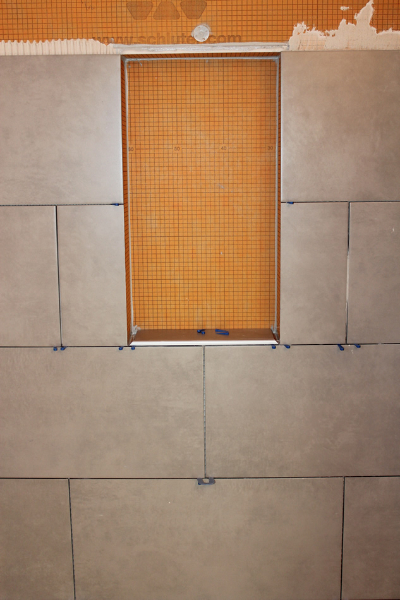
Once your niche space is waterproofed you can do just about anything you want with it as far as design is concerned. That is not to say you should cut out and build the niche space then decide what to do with it – you need to know what you’re going to do with it before you start.

Finished waterproof shower niche

Run tile up to niche sides

The niche I’m using for these posts is simply an empty shelf in the wall. There are no additional shelves or design elements incorporated into it. We’ll get to that in a bit. This one is very simple, though. We will just place one full tile in the back and install bullnose pieces on the sides.

You can start by running the remainder of the wall tile up to and around the bottom of the niche and the sides. (I did not do both sides of my niche yet because of the distance to the back wall – you should.) Do not run the tile over the top of the niche yet.

If you’ve planned it correctly your grout lines should be lined up with the top and bottom of the niche like they are in the photo. Depending on your layout, design, or framing this is not always possible but if you can line them up it looks better most of the time.

[continue reading…]